Welcoming and dog-friendly Montagu Arms Hotel in Beaulieu is hosting an exciting line up of events and activities to celebrate Month of the Pooch this August.
May is a magical month as once again tiny foals are being born all over the New Forest, soon to be seen gambolling about and winning our hearts.
Please take extra care on the unfenced roads.
Foals move very fast and are unpredictable.
Some of them even lie on the road!
So give yourself plenty of time on your daily commute, or when crossing the Forest at any time.
A very simple message and easy to remember is the "Shared Forest" mantra to #add3minutes and arrive safely to your destination.
The Shared Forest is an initiative of the New Forest Commoners which started in 2017 at the New Forest Show. It is aimed at increasing public awareness of commoning – both as a modern farming system and as an important part of the New Forest’s cultural heritage. The aim is to encourage local residents and visitors to understand this important aspect of New Forest life, and to help safeguard their animals grazing on the open Forest.
The attendant publicity at the launch of #add3minutes helped to save animal lives through the autumn and winter of last year.
Now it's test time again, to remind ourselves that foals move much faster and less predictably than their mothers. Which is why it's vital to be really aware, slow right down in any case if ponies are close to the road and look out for these gorgeous babies on their long legs, which have absolutely no idea whatsoever that the road is a dangerous place to be.
The Shared Forest welcomes businesses to sign their charter and become members. The idea is that a business then takes some responsibility, for ensuring that its staff adhere to the speed limits and indeed drive much more slowly than the limit according to road and weather conditions and the presence of animals in the vicinity.
It already has 30 business members across the New Forest and beyond, with more in the process of joining - more details on their website.
If one more reminder were needed just look at how tiny and defenceless they are when first born....


Lymington lies on the A337 which runs from Christchurch to Cadnam. From the west (Bournemouth and Poole direction), the simplest route is the A337 via Christchurch, Highcliffe, and New Milton.
From London, M3 or the north, you have a choice. The easiest and most scenic route is to take the M27 to Junction 1 (Cadnam/The New Forest) and then follow the A337 through Lyndhurst and Brockenhurst. However, do check traffic reports as Lyndhurst can get very busy at holiday times.
Another option is to leave the M27 at Junction 3, then take the M271 to Totton, then the A326 towards Fawley then the Beaulieu Road through Beaulieu to Hatchet Pond where you’ll fork left on the B3054 to Lymington. This will bring you in across the beautiful Lymington River - you’ll see the Isle of Wight ferry terminal to your left as you cross over the river, and the Lymington Shores development as you cross the railway line.
The Lymington line is a branch off the main Waterloo to Weymouth line, change at Brockenhurst for Lymington Town and Lymington Pier (for the Ferry). It’s a ten minute scenic ride along the Lymington River to Lymington Town Station – and then on to Lymington Pier if you’re heading to the Isle of Wight via ferry to Yarmouth.
Lymington Town Station is very close to the centre of Lymington. Walk straight up Station Street from the station (passing the wonderful Bosun's Chair pub with rooms - great food and atmosphere!) and turn left into Gosport Street, which brings you to the bottom of Lymington High Street passing several of our lovely Lymington shops and hostelries on the way.
There are a number of companies offering coach trips to Lymington, here are a few:
Go Euro - Cheap bus and coach tickets from London.
National Express - Coach trips from London and Bournemouth.
Buses run to Lymington from Bournemouth and Southampton:
Bluestar - Bus service from Southampton areas, Ashurst, Lyndhurst and Brockenhurst.
More Bus - Bus routes from Bournemouth, New Milton, Beaulieu and Hythe. The X1 runs to and from Bournemouth.
The New Forest Tour operates open-top buses during the summer months, with green and blue routes stopping in Lymington. A wonderful way to visit the New Forest National Park, its towns and villages.
If travelling to or from the Isle of Wight from Lymington, Southern Vectis operate buses on the Isle of Wight, some stopping at Yarmouth by the ferry terminal.
The Wightlink Passenger/Car Ferry to Yarmouth, Isle of Wight takes about 30 minutes and in the summer generally leaves every 45 minutes from Lymington Pier. Coral Star operates from April to September each year, stopping at Lymington Quay and also the Harbour Master's Pontoon by request.
Wightlink - Large ferry service for cars, bikes and foot passengers with regular services.
Coral Star- Offers a Yarmouth-Lymington foot passenger ferry service through the summer April to October.
Southampton Airport is the main airport on the south coast and is connected directly to the rail network. Bournemouth Airport (previously known as Hurn Airport) to the west is only accessible by road.
Southampton Airport arrivals and departures
Bournemouth Airport arrivals and departures
Local Taxi and Airport Transfer Cars
In Lymington, you can hire bicycles from Figgures Cycles in Henderson Court and from New Forest Bike Hire in Quay Street.
In Brockenhurst cycle hire is available near the station with Cyclexperience, including electric bike hire.
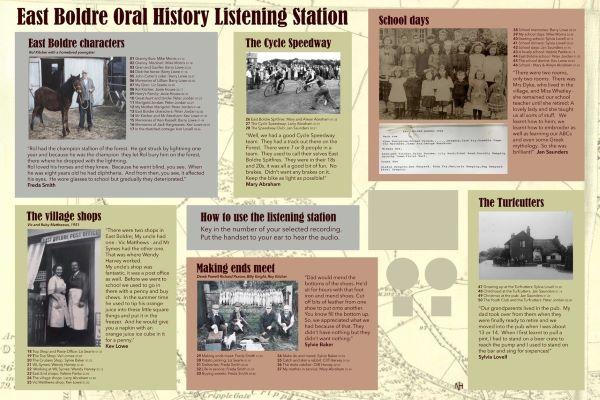
East Boldre Oral History (EBOH) has gathered and collated fascinating reflections which are spoken aloud by living residents of East Boldre who were born and brought up in the village, whose memories stretch back to encompass a social history which thanks to the pace of change seems to speak from long, long ago!
This exciting project explores how the village has changed, from its origin as a squatter’s settlement to the present day.
Listen at various listening stations see below - including in comfort over a pint and home cooked meal at the Turfcutters Arms!
We'll start to feature individual stories in coming weeks in Weekly What's On and across our social media...
To follow the individual stories which we shall feature over coming weeks, if you don't already receive it sign up now for our Weekly What's On e-newsletter (including many community events which are free or low charge). You can also follow us on Facebook, Twitter and Instagram where we shall share the stories too. It's also free to add your own events to our Events Calendar.
Listen to the stories through the listening stations at the Turfcutters Arms, in the village and at Hatchet Pond EBOH has recorded and transcribed memories from residents and now the stories can be heard through listening stations which have been installed in the village.
The Turfcutters Arms houses a listening station where the public can hear stories about East Boldre Characters and childhood memories (this is accessible during pub opening hours)
Three further listening stations are installed in East Boldre Village Hall and School Fields Trust Hall (these are accessible by appointment).
Oral history interpretation is also sited in the adopted BT kiosk at Hatchet Pond village - this includes a QR codes which link to a sound cloud where audio recordings are available:
https://soundcloud.com/user-510714237
The aims of the project which as you can imagine has taken some time in the making were to:

• Record memories and tales of an East Boldre as it was.
• Install a sense of community and pride – giving a voice to the families who have lived in the village for generations and who are aware of the fast-changing community.
• Capture memories before they are lost.
• Help people who live in or visit East Boldre recognise its history and character.
• Encourage people to share time together to talk about heritage.
• Celebrate gypsy traveller and commoning heritage.
• Work with local schools to help children understand the village history. We have run workshops at South Baddesley, William Gilpin and will also work with Beaulieu School; taking contributors to the schools to discuss their memories.
This fascinating project has had support and funding from: New Forest National Park Authority, East Boldre Parish Council, Hampshire County Council, Beaufort Trust, East Boldre Village Hall Trust, East Boldre School Fields Trust, NF Heritage Centre and New Forest District Council.
Sadly Covid 19 has temporarily scuppered plans for a big official opening of the listening stations but we there are plans to celebrate when restrictions are lifted. This has been a hugely successful project which celebrates heritage and pride in belonging to an amazing community!
We plan through the coming weeks to showcase some of the individual stories and give everybody a little taste of life in the not so long ago past yet some of which feels as though it took place very long ago indeed, such is the pace of change!
Introducing local historian Andrew Duncan and his new book Somerville's War - which features not only infamous spy and traitor Kim Philby but also Andrew's own mother, who along with other courageous women played an important role in the Second World War.
"Getting a first novel noticed in your late 60s can be as hard as winning the Round the Island Race in a pedalo. However, a local setting for the story may, in theory, help you off the starting blocks.
Somerville’s War begins and ends in 1940-41 at Beaulieu, renamed Somerville. Lymington, its neighbouring town, renamed Milton, comes into the story together with a cast of Somerville residents. Its main female character is a local girl who gets caught up in a tense Spitfire dogfight over the heath to the north of Beaulieu and Lymington, escaping over the Solent and round the Needles. Dan Snow has described the story as one for ‘anyone who loves the New Forest’ – however its scope is much wider than just the Forest, the action moving to London and then occupied France.
My family have lived at Beaulieu since the 1920s so I could rely on some local knowledge and insights. The main male character, Brigadier Maxwell, has a house on the Beaulieu River and is loosely based on my grandmother (yes, trans-gendered into a man) who also lived on the river. He is captain of the local sailing club, and although odd – he almost never speaks and when he does it’s an agonizingly slow drawl – no one suspects that he is leading a double life. Instead of going back to London each week to the War Office, he is doubling back unseen to help set up a Special Operations Executive (SOE) finishing school for spies, agents and saboteurs in the woods behind the Beaulieu village.
SOE Beaulieu is far from fictional: among its graduates are some of WW2’s most famous men and women agents including Odette Churchill (pictured right) who survived torture by the Gestapo, Violet Szabo who died in a
concentration camp and Ben Cowburn, hero of at least four dramatically successful missions.
One of the SOE Beaulieu lecturers was none other than master spy and traitor Kim Philby (pictured below left). This is moderately common knowledge, but not the fact that his subject was black propaganda and subversion. Even today, historically aware Beaulieu residents find it extraordinary, perhaps a bit creepy, that this supremely dangerous man spent time in Beaulieu. His fictional counterpart in the story is Adrian Russell who, bored with teaching (as Philby was – he itched to get back to London) decides to amuse himself by subverting the local sailing club.
The fictional possibilities of Maxwell and Philby seemed to me to be interesting, and gave me a start with the plot. To add some spice Maxwell’s daughter Leo, who is training to be an ATA (Air Transport Auxiliary) pilot is also having a romance with one of Maxwell’s trainees Labrador, a mysterious Pole, at the spy school. My mother (who died 1988) was one of the 160 ATA ‘Spitfire women’ and as far as I know the only one to have grown up in the New Forest, so I had some first-hand material for that strand too.
Leo has another admirer, Henry Dunning-Green the son of a wealthy local family, whom she finds dull. Unknown to her, he is also training as a saboteur at SOE Beaulieu.
How she, Labrador and Henry end up under the same roof in occupied France on a do or die mission is for you to discover. People are saying that it did keep them turning the pages.
So if you want a story with strong local interest that – as the reviews put it – is ‘enthalling’, ‘high-octane,’ a ‘great read’ and a ‘sensitive story of relationships’ then Somerville’s War may be for you. In the best tradition of intelligent thrillers it’s intended to be not just a compelling read but a psychological tale which may help you understand why humans are so prone to obsession."
Somerville’s War by Andrew Duncan can be purchased from bookshops and online.
For more information and a video see the book’s website, www.somervilleswar.com
If you have enjoyed reading this article and you don't already receive our Lymington and New Forest Weekly What's On e-newsletter do sign up here to receive it direct to your inbox on Friday mornings!
This week's reflection by Mark based on one of Hugh's skilful and amusing cartoons brings us back closer to home and our familiar environ, to Buckler's Hard.
"When I was a boy my family used to take the annual summer holiday in a chalet on the cliffs of Whitsand Bay in Cornwall. One day my father told us that a famous yachtsman who had just sailed all the way around the world was coming home. I remember being handed his heavy binoculars to view the huge fleet surrounding his boat as he slowly crossed the bay from west to east, then around Rame Head and into Plymouth. Then I remember the television news of him being knighted by the Queen at Greenwich. The sword was the one used by Queen Elizabeth the First to knight Francis Drake, now that really is history.
The famous yachtsman was of course Sir Francis Chichester and his epic voyage started and ended at Buckler’s Hard. I have stayed at the Royal Southampton Yacht Club marina at Gin’s Farm a few times and I think it’s a delightful place. I can understand why Sir Francis made Buckler’s Hard his home port. The far-reaching marshes with the almost unbroken sound track of warblers chattering away as they perch safely in the depths of the reeds are restful to the soul. Many marinas are busy places full of activity. Not this one.
In a previous article we spoke of graffiti and the fact that some of our Forest trees are defaced with simple messages of undying love. Others are marked with the Royal broad arrow signifying that the tree was destined for shipbuilding. In Nelson’s time these slow growing oaks were being harvested at an alarming rate, far faster than they could replenish naturally.
Alternatives were tried, non-native trees for instance, but what saved the oaks from further depletion was iron. This new ship building material saved the oaks of the New Forest. A great many ships were built at Buckler’s Hard including Nelson’s favourite, HMS Agamemnon. Sailors, bored with the trend for unpronounceable historic names, invented their own. The Agamemnon became ‘ham and eggs’.
When you visit Buckler’s Hard, please stop awhile at the top of the gentle slope that ends at the river. Take in the cottages at either side and then, at the base of the slope, the river into which was launched some of England’s most fearsome warships. As someone who used to sail small yachts, I have stood and stared with incredulity from the top of the hard, to me the idea of launching and then manoeuvring a massive ninety-gun ship in such a small area is hard to imagine. This ship was 170 feet long and 44 feet wide. Those ancient mariners must have had a great deal of skill to have achieved so much with just oars. After all, there are more bends in the river than the average anaconda. Sailing out would be an utter impossibility so it could only have been human power that did the job.
There is a riverside walk that takes you all the way down the west bank of the Beaulieu River from the village itself to Buckler’s Hard. On the way you will pass Bailey’s Hard which is where the old brick works used to be, the kiln is still there. (See previous article, Home sweet home - see link below.) The walk is a delight and there can be few sights more relaxing than that of small boats on swinging moorings in sheltered waters. I wonder if much has changed here? Would a sailor of Nelson’s time see a great deal of difference between now and then? Most trees grow and die in a short time and as such the vegetation might have changed but then, oak trees last a very long time, yew even longer. But the hills, the curve of the river, the marshes, I doubt much has changed in the last three hundred years.
In order to understand exactly how important any port is, let alone Buckler’s Hard, you need to listen to two stories.
The first is from a work colleague. He was offered a free trip on a yacht from Cherbourg to Southampton. The owner wanted crew as it was a long trip so my friend packed an overnight bag, kissed his wife goodbye and duly took the ferry over. So far so good. When they left France, the weather was ‘a bit blowy’. During the crossing the wind strengthened and, proportionally, my friend’s seasickness worsened. Sent down below to his bunk he curled into a miserable ball and pulled blankets over himself as he willed the nightmare to end. He actually said to me as we sat in the office all those years later that if someone had handed him a pistol, he would have shot himself. I laughed and told him not to exaggerate. His face darkened, he was utterly serious, yes it was really had been so bad that he would have ended his life there and then. I was shocked.
The second story concerns our very own cartoonist Hugh who as a young boy with his mother and younger brother were on board a troop ship on a passage to Egypt. He tells me that when they were crossing the Bay of Biscay the weather was so bad and the movement of the ship so awful that he actually prayed to God to end his life. Again, a shocking thing to hear.
This is what a port, a safe haven, is all about. It’s about safety, shelter and succour. A port represents more than a place to tie the old girl up or to paint her with anti-foul. A port can mean the difference between life and death. Ports are important, regardless of size.
Imagine the joy that Sir Francis Chichester felt when he entered the calm waters of the Beaulieu River all those years ago. Enjoy the tranquility.

If you enjoy these skilfully told tales and cartoons and you don't already receive our Weekly What's On e-newsletter to receive each week's as it's published - sign up here!
Meanwhile if you'd like to read previous articles on diverse subjects written by Mark and illustrated by Hugh's cartoons here they are, click the links embedded in the titles:
Salisbury Cathedral
Pond Life in our Forests
Bombs Away
Baileys Hard
Rufus Stone and Sir Walter Tyrrell
Graffiti through the ages
Freedom of the roads
Heath fires
Lymington Lido
Watch the birdie
Unstoppable momentum of nature
Socially distanced socialising
Calshot Spit, a curse for mariners...

"This may sound incredible but just eight thousand years ago there was no Solent and there was no English Channel. Both were as dry as the mid-summer New Forest heathland. If you wanted to pop across to Calais for some cheap wine and fags you could grab a rucksack, pull on your best boots and walk there. If the local shop in Lymington was out of milk then all you had to do was stroll over to the shop in Yarmouth. At that time, England, the Isle of Wight (then just a chalk outcrop) and Europe were as one.
When I was a sailing chap, my boat was moored at Ocean Village which happens to be the base for the Royal Southampton Yacht Club. Friends, who are members, invited us there one evening to hear a talk given by the Hampshire and Wight Trust for Maritime Archaeology, a charity now known as the Marine Archaeology Trust or MAT. It was fascinating and informative. Did you know that there are fossilised trees in the Solent? Did you know about the submerged village twelve metres beneath the surface at Bouldnor Cliff? This Atlantis of Hampshire is situated just to the east of Yarmouth. Fishermen working the western Solent have reported finding flint tools in their dredges since the sixties but only relatively recently have experts started to catalogue finds.
Bouldnor was discovered because a sharp-eyed diver happened to notice that a burrowing lobster was ejecting pieces of flint from its tiny excavation. On closer investigation these pieces were found to be tools, a sure sign of human occupation. To date, divers have found all manner of objects from the past including worked timbers suggesting large buildings or perhaps boats. The Trust believes that the main reason we know so little about this period, the Mesolithic, is because most of the sites are now underwater.
Now we take a short trip from the Western Solent to the mouth of Portsmouth harbour.
The wreck of the Mary Rose was discovered in the Solent outside Portsmouth in just twelve metres of water. As a result of the sheer determination and persistence of just one man, the late Alexander McKee, the wreck was eventually raised and thousands of artefacts were recovered. Initially he fought the tides, he struggled with officialdom and a lack of faith from almost all he tried to involve. In the very beginning he wasn’t even allowed to put a buoy on the site. Each time he re-visited the wreck at slack water he had to use careful navigation to be sure of his position. Fortunately, Prince Charles became involved with the project and the rest is history. In my opinion the brand-new Mary Rose museum is an utter treat well worth a visit. The care and commitment that has been put into the display of the various exhibits is a testament to first class marine archaeology. You’re probably aware of the dozens of bows and arrows that were found but did you know about the backgammon set? Did you know about the incredibly intricate combs that the sailors used to combat lice? How these combs were created using hand tools is beyond me.
Most of northern Europe was once covered with an ice cap and when this melted, water levels rose. We’re not talking about today’s random estimates of a foot or two. No, this was real warming. We are talking about the creation of the English Channel and our Isle of Wight. (The creation of seas, for which, all ferry companies ought to be extremely grateful). In terms of time, let’s look at how recent these events really were. The Mary Rose foundered just five hundred years ago. Stonehenge was created three thousand years ago. The Mesolithic village at Bouldnor? Eight thousand years ago. In terms of the age of our globe these events are very recent indeed. In the eighties we were told that due to man-made global warming the Maldives would end up underwater, submerged, disappeared. As far as I am aware these pretty islands still exist and scare stories of this nature are divisive and unhelpful. Perhaps we ought to look at the massive climate changes that have occurred in the recent past and compare them to what is happening today. I’m not sure that things are really that bad, are you? I wonder what today’s febrile media would make of the frost fair that took place on the Thames just two-hundred years ago?
Should you take the ferry from Lymington to Yarmouth, take a look to the west where you will easily see the Needles. Just beyond the lighthouse is the wreck of the Varvassi. At low tides parts of her are still visible and a hazard to those who choose to sail too close. She was carrying a cargo of wine, much of which ended up on the shore. The year 1947 must have been a good year for wine loving beachcombers. MAT has found other wrecks which they survey meticulously, fighting the ravages of time and tide in order to record what evidence remains while there is still time to do so.
The work of these dedicated people, many of whom are volunteers, gives us all a peep into the past, a hint of what life must have been like for people who lived in a world without electricity, running water or Tesco. In the case of a wreck, we can only imagine the terror of the poor sailors as their home crunched and splintered on the rocks before sinking. If you want to get some idea of how dangerous these waters can be just look on-line where you can see the wrecks in our area. There are many.
But in the meantime, enjoy the fruits of the labours of some extremely skilled and dedicated divers who have carefully recorded some of our underwater past and indeed continue to do so."

If you enjoy these skilfully told tales and cartoons and you don't already receive our Weekly What's On e-newsletter to receive each week's as it's published - sign up here!
Bucklers Hard
Salisbury Cathedral
Pond Life in our Forests
Bombs Away
Baileys Hard
Rufus Stone and Sir Walter Tyrrell
Graffiti through the ages
Freedom of the roads
Heath fires
Lymington Lido
Watch the birdie
Unstoppable momentum of nature
Socially distanced socialising
Calshot Spit, a curse for mariners...

This week's instalment from our intrepid duo, writer and crafter Mark and cartoon magician Hugh!
"The Top Gear presenter Jeremy Clarkson has always been known to be a harsh critic of what he refers to as ‘shed engineering’. This is his favourite pejorative term for low volume manufacture which he seems to detest. His ideal would be a shiny factory with painted floors and an imposing marble floored reception dotted with wasp-waisted secretaries. I don’t think I need to tell you that major manufacturing facilities don’t magically appear with the wave of the engineering fairy’s wand. As the ancient Chinese proverb states, ‘Even the longest journey starts with just one step.’, and so it is for engineering.
Soichiro Honda left school at fifteen and became an apprentice at a garage where he repaired and serviced cars. After six years he returned to the family home and began to make motorcycles in a wooden shack on the property. Are you by any chance familiar with the name Honda? William Morris started out making bicycles until he decided to build his own car, the Morris Bullnose. Realising that he didn’t quite have the facilities to create a car from scratch he used existing parts from other manufacturers. Once he had a financial toe-hold, he pressed on and eventually became a major manufacturer in his own right. There are countless major brands that started with the vision and expertise of one individual. An individual that often started out with just a shed.
Close to my home is a small workshop which houses the most incredible machines and it is run by just one man. These machines are computer controlled, work night and day if required, and produce parts to the exact specifications without so much as a coffee break. This particular workshop is a little larger than a shed, but not much. I’m friendly with the proprietor and the other day I needed two small parts made from brass. He said he could do them within the week but they were ready the following day. Out of curiosity I asked about some tiny parts, smaller than a broad bean, that were on his desk.
“Oh, they’re pawls for the release mechanism for the guns fitted to a Spitfire. There are a couple being restored not far from here.”
Entranced, I turned the tiny part over in my fingers, fascinated by the complexity. He told me how the various warplane restoration groups, who work for wealthy individuals, tend to help one another. After all, Spitfire parts tend to be tricky to source. When one of the restoration groups discovered his tiny workshop and his high-quality work, word spread fast. Now he is talking to aircraft restoration engineers across the country helping them to painstakingly rebuild these historic aircraft to the highest specifications. This isn’t a job, it’s a privilege.
Most small workshops seem to be slightly scruffy and a little down at heel. It seems to be the way engineers prefer things. But not Jeremy Clarkson. A long time ago I was pursuing a patent for a new engineering idea. I needed expertise way beyond my abilities and so I took myself for a walk to Riverside Park where there is an elevated model railway. Model railway engineers are talented and multiskilled individuals who build, from scratch, the most handsome miniature steam engines. After asking around I was given an address and soon I was knocking on the door of a very normal semi-detached house in Bitterne Triangle. His wife seemed entirely at ease at the arrival of a strange visitor wearing a serious expression and clutching engineering drawings. I was taken down the hall, through the kitchen and down to the shed where I was introduced. He shook my hand, sat me down and we began to talk. Whilst he studied my drawings, I had time to take it all in.
The shed seemed to have morphed from what was once a simple space into a multi compartmented one. There were all kinds of machines shoehorned into the tightest spots beneath the low ceiling. I saw many wooden drawered cabinets with tiny labels grubby from a thousand thumbprints with faded handwriting describing the contents, drills, taps, reamers and much more. The floor, which was concrete, had been impregnated with a hard and shiny layer of compacted oil and metal filings; there was a politically incorrect calendar on the wall. The smell was simply that of a workshop, predominantly oil.
Once he had finished, he said,
“I can do it, but not for a month. You see it’s the start of the Formula 1 practice season.”
There was a pause as my chin gently touched the floor.
“Yep”, he continued with a smile as he continued to look at my hand drawn designs, “they’re good for business and because they’re such a novice team they keep breaking things! They need their replacement parts right away, if not sooner.”
There I was, a naïve young man with a dream, and I was talking to someone who was an integral part of the top flight of motorsport, in a shed, in Bitterne Triangle, in Southampton. Incredible! But not as incredible as the fact that because he couldn’t help me right away, he directed me to another, equally well-equipped shed just one mile away.
These small outfits are the backbone of British engineering. Our tiny workshops are utterly indispensable as larger concerns are only interested in high volume, low profit orders. It is a fact that seven out of the ten F1 teams are based in this country. We are fortunate enough to enjoy such a wealth of engineering excellence that this tiny island of ours is often the first port of call for top motorsport teams. Perhaps the next time you are watching F1 cars on the box, or if you are really lucky, live, consider the origins of some of the parts. There’s a chance that they might have been created not far away.
Shed engineering Jeremy? British excellence, actually."

Thanks to the Beaulieu Estate and National Motor Museum for the use of the wonderful workshop.
If you enjoy these skilfully told tales and cartoons and you don't already receive our Weekly What's On e-newsletter to receive each week's as it's published - sign up here!
When the Isle of Wight was just Wight
Bucklers Hard
Salisbury Cathedral
Pond Life in our Forests
Bombs Away
Baileys Hard
Rufus Stone and Sir Walter Tyrrell
Graffiti through the ages
Freedom of the roads
Heath fires
Lymington Lido
Watch the birdie
Unstoppable momentum of nature
Socially distanced socialising
Calshot Spit, a curse for mariners...

The latest chapter from writer and crafter Mark and cartoon magician Hugh. Grandparents especially will potentially smile particularly.
"Some of my warmest memories revolve around the time that my family, just returned from a four-year stint in Mauritius, lodged with my father’s parents in a tiny council house in Plymouth. My grandfather, Sydney, was a welder who worked in Plymouth Dockyard, a career spent amongst toxic fumes and abrasive dust that would end his days prematurely. My grandmother, Jessie, was in the old-fashioned way, a housewife; I remember her horribly twisted fingers, deformed by years of wringing out washing by hand. We were there in 1966, the year that England won the football World Cup. Coal fires were commonplace and even today the slightest whiff of coal smoke takes me back to those grim but happy times.
I wonder what will be the touchstone that rekindles our memories of these Covid times? The sight of a mask perhaps? The cold sensation and alcohol odour of antibacterial hand wash? I personally feel that we have all enjoyed an increased sense of community and sense of caring for others. Certainly, our little neighbourhood has been brought together. I wonder if the virus has ‘re-set’ our values and priorities? Perhaps the mind-numbing media repetition and parliamentary confusion has turned us away from the television and towards our neighbours? It would appear that the combination of lock down and furlough has, in a strange way, brought us closer together.
In the evenings it was often the case that the black and white television was switched off and the grubby, dog-eared playing cards came out of the drawer. They were so greasy and sticky that shuffling them was a trial. We used to bet using pennies, strictly speaking this was underage betting but it was all innocent enough. Also, we would play dominoes which I seem to remember was an easy game to play but a difficult game to win, especially against experts like Sydney and Jessie. Today I have forgotten those games which I find a great pity. You see, I can still remember the restful silence as, with the clock ticking and the coal fire glowing, we pondered our choices. Today, home entertainment is almost always televisual and is generally accompanied by a speaker system that could deafen a county. Whatever happened to thought?
My grandparents had a little game, the secret of which was kept from us for many years. Sydney would arrange random objects on a table, a pepper pot, a mug, that sort of thing and then he was asked to leave the room. We always checked to make sure he couldn’t peep. One of us would reverently touch one of the objects and then the drama would begin. We children hardly dared to breathe as Sydney came back into the room and, Svengali like, slowly wafted a spoon over each object in turn. The tension for us children was exquisite. The boredom for our parents, who were fully aware of the gig, extreme. As the spoon passed over the chosen object, Jessie would give the tiniest cough or sniff. Naturally, Sidney would make several more passes with the spoon as he waited for ‘the vibrations’ but eventually he would tap the correct object. Time and again, we were amazed at his incredible psychic gift.
A friend once told me that her father had a secret trick which he would play every Christmas without fail. As they were eating the Christmas pudding, he would carefully reach into his pocket to retrieve a tightly folded ten-pound note. Then with the note pinched between finger and thumb he would reach into his mouth and exclaim to the family that he had found it again! To compound the agony, he would slowly unfold the note in front of the gullible children. The secret was kept for many years.
There is an ever-increasing array of electronic entertainment and information available to all of us and, seemingly, on every subject. However, there are simpler pleasures to be had of the unplugged variety. It’s down to us to gently guide the younger generation away from the mindless stuff and towards the thoughtful stuff. Not an easy task, but one that I know you are capable of.
They do say that good parents lead by example. Imagine you are a grandparent at a family dinner, perhaps a celebratory gathering. Would you ever dream of ignoring everyone as you studied your smart phone? I think you’ll agree that good parents, and grandparents, help to foster good conversation by intervening when there is poor behaviour. The addictive nature of smartphones is well documented. Apparently, youngsters check their phones for messages roughly every fifteen seconds. Perhaps if parents and grandparents were to make a stand against this kind of behaviour the result might well be interesting and engaging conversation. After all, we’re only talking about good manners.
My father told me that back in his day everyone had their party piece. This is because without modern home entertainment you simply made your own. The alternative would have been to stare at one another like so many cows in a field. Many could sing and had memorised whole songs with the audience joining in for the chorus. Some, like Sydney, had learned tricks of various kinds. Essentially everyone was expected to bring something to the party. Those who could play the piano were especially in demand. As you can imagine, those who were supremely talented often ended up on the stage but the level of expertise at domestic level was more than enough for an enjoyable Saturday evening with friends.
I suspect that these days if there was a power failure the majority would be utterly stumped, incapable of entertaining themselves or others. How sad.
As a lad I enjoyed darts. On the face of it this is the simplest of games You simply stand at a line and throw pointy things at a wall, hardly Mastermind. But there’s a catch, and that is of course, maths. If you want to learn multiplication, division, addition and subtraction, play darts. If you think that a maths examination is arduous then try to ‘chalk’ in front of a group of seasoned players. Any errors will be spotted immediately and roundly mocked. Generally, darts is a quiet game in that when a player is throwing others tend not to chatter. As for simplicity? Imagine you have 104 left. An expert player will tell you, in no more than a moment, that you could try a single nineteen then a treble seventeen in order to finish on double seventeen. Did you manage to work that out? When I was a player my mental arithmetic was superb, why not buy a board and watch as your children and grandchildren prosper while laughing.
Scrabble, the perfect game for resting the ears and expanding the mind. We all know that there are fanatics. Those who spend hours memorising words arcane and obscure in order to use up those last tiles to win the game. The rest of us stumble along, considering it a minor miracle when we achieve a three-letter word. In my circle of friends, a six-letter word earns a round of applause! (Then afterwards the inevitable, simmering, silent envy). There is maths to be found here as well. Far simpler than darts but maths all the same, our eyes are drawn to the triple word squares as we yearn for just one precious vowel. We hope that somewhere, in some language there is the word xydeliv, (there isn’t).
Personally, I worry for the computer gamers of today. I see more and more basic errors in maths and English. The gamers of today could probably count the number of blisters on their fingers and thumbs, but without a calculator? Not much else. If you are under the age of twenty and reading this, why not try one of the pursuits above? Let a little silence into your life. Rest the ears, stimulate the little grey cells.

Image supplied by Rijksmuseum Amsterdam. With acknowledgement to Johannes Stroebel’s ‘Syndics of the Leiden Saalhal’ 1866
If you enjoy these skilfully told tales and cartoons and you don't already receive our Weekly What's On e-newsletter to receive each week's as it's published - sign up here!
The joy of sheds
When the Isle of Wight was just Wight
Bucklers Hard
Salisbury Cathedral
Pond Life in our Forests
Bombs Away
Baileys Hard
Rufus Stone and Sir Walter Tyrrell
Graffiti through the ages
Freedom of the roads
Heath fires
Lymington Lido
Watch the birdie
Unstoppable momentum of nature
Socially distanced socialising
Calshot Spit, a curse for mariners...

For the Bank Holiday Weeked writer and crafter Mark and cartoon magician Hugh cover one of our favourite subjects: the amazing and little known role played by women in the history of aviation.
There is a long and sad history of prejudice against women. I’m sure that this baffles you as much as it baffles me.
I’m painfully aware that, as a young and immature boy, I misbehaved in school. I failed to achieve anything close to my potential and ended up at just a technical level. I must be blind in terms of human origin because, to me, a person is simply a person. Their gender or country of origin is irrelevant. What really matters to me is what’s beneath the skin and between the ears. In my previous technical role when I needed guidance from an engineer, I didn’t care a jot whether the person sat opposite was male or female. The person I was facing had passed many examinations and, ultimately, through perseverance and hard work, become an engineer and I respected that enormously.
Unfortunately, a great deal of blame for any kind of prejudice must be laid at the feet of parents. Children are largely a product of them and are easily influenced. Ignorant ideas implanted at a young age can take some time to be erased.
The history of flight has been overwhelmingly dominated by men but, just occasionally, we have enjoyed learning about the bravery of some very special women indeed. The word bravery is valid here because at the time of early aviation flyers learned by their mistakes which were often fatal. For those of you that know a little about the WW1 airfield at East Boldre it should come as no surprise that the vast majority of Royal Flying Corps pilots killed were those learning to fly over our Forest; not those flying in action over trenches in Northern France. These pioneers were brave, death was a very real possibility. Think of that when you next board a modern passenger jet. In the thirties, pilots flirted with death at every flight. Today, flight is just a commute, an airborne taxi. In the thirties we had genuine heroes, flyers fully aware that the next flight could be their last, flyers that went back for more time and again. Today we hear of certain sportsmen described as heroes. Seriously? I know what my vision of a hero is and he or she won’t be kicking a bag of wind around a pitch.
Probably the most well-known female pilot is Amelia Earhart who was born in Kansas. She became infected with what was the Covid of its day. In 1918 she was working as a nurse in a Spanish Flu ward when, unsurprisingly, she contracted the virus. After two months, she was in the clear but the virus had badly affected her sinuses which, with antibiotics still in their infancy, required painful and initially ineffective surgery.
Her fame began when, in 1928 she was invited to crew on a trip across the Atlantic, the other two participants were a pilot and an engineer/co-pilot. Earhart was not trained to fly using instruments and, as the majority of the trip was completed under instrument flying rules, all Amelia did was fill in the flight log. When she was interviewed about the flight afterwards, she referred to herself as ‘just a sack of potatoes’ adding prophetically that she ‘might try it solo in the future’. Oh, did she ever.
Her return from the 1928 flight was greeted with a ticker-tape parade, suddenly she was famous. Amelia was a strong promoter of women’s rights and she used her fame to attack anything to the contrary. After her joint trans-Atlantic flight, she set about making her own flying reputation and she began to get involved with air racing. When she heard that the organisers of the 1934 Bendex Trophy race had banned women competitors, she openly refused to fly the world-famous screen actress Mary Pickford to the event. On marrying George Putman, she wouldn’t follow the norm in taking his name and sometimes even referred to him as Mr Earhart. Today this is accepted but back then it was rather shocking. She insisted that each of them shared the household duties. What she was actually insisting on was that the husband did his fair share, no bad thing.
In 1932 at the age of 34 Amelia took off from Newfoundland and headed for Paris. After a fifteen-hour solo flight she landed in a field in Northern Ireland. An inquisitive farm hand asked if she had come far and she replied, America. What a woman. What determination and bravery. Being the first woman to fly the Atlantic solo she was showered with awards and quickly developed friends in high places, all the way up to the White House in fact. We can be sure that her attitude regarding women’s rights were heard by some rather senior people, certainly Eleanor Roosevelt. The success of her cross-channel flight led on to more record breaking flights, further racing, including competing in the 1935 Bendex Trophy (how quickly they changed their minds about women) and the setting of many distance records. Then Amelia decided to go for something really big. She wanted to fly around the world. Sadly, during the attempt, her life was taken from her somewhere over Pacific Ocean and despite a huge search operation, no trace was found. The world was a poorer place without her.
During WW2 the ATA was formed in order to move finished aircraft from the factory to active squadrons and also to carry out air ambulance work. The women flyers were enormously popular in the public eye and were, incredibly for the time, paid the same as men. Incidentally, at the same time, US female pilots were being paid as little as 65% of the male rates.
I’m sure that at some time or other you have jumped into a strange car, struggled with unfamiliar controls and generally taken a while to familiarise yourself. These young women jumped into unfamiliar aircraft! One flight might be a light, nimble, single engine Spitfire, the next a four-engine lumbering giant of a Lancaster! Naturally the women received thorough training before qualifying on each aircraft. There was no rigid schedule, they were allowed to learn at their own pace However there was risk, fifteen young women died during these delivery trips.
One pilot, Helen Kerly, was awarded a commendation for successfully delivering a Spitfire which had developed technical difficulties during the trip. Jackie Cochrane was an American ATA pilot who started the Women’s Airforce Service Pilots organisation or WASP which controlled over a thousand women who carried out the same duties as the ATA but in the US.
It has been said many times that ‘Any fool can go on doing what’s been done before, but it takes real guts and determination to do something different.’
Women that ‘did something different’ improved the rights of women across the globe. We still have a long way to go but the early aviators showed men that women are every bit as equal and often better. If you’re in any doubt take a look at the roll call of women who have travelled into space, Helen Sharman for example who was born in Sheffield and went to a comprehensive school. There are some who, tragically, have paid the ultimate sacrifice for space exploration but the example of women aviators and astronauts has given inspiration to many others. Others who now look at the idea of flight and of space exploration as a real possibility. Sixty years ago, these ideas would have been seen as fantasy.
Way to go ladies!

If you enjoy these skilfully told tales and cartoons and you don't already receive our Weekly What's On e-newsletter to receive each week's as it's published - sign up here!
Bees pollinators par excellence
Cordless home entertainment
The joy of sheds
When the Isle of Wight was just Wight
Bucklers Hard
Salisbury Cathedral
Pond Life in our Forests
Bombs Away
Baileys Hard
Rufus Stone and Sir Walter Tyrrell
Graffiti through the ages
Freedom of the roads
Heath fires
Lymington Lido
Watch the birdie
Unstoppable momentum of nature
Socially distanced socialising
Calshot Spit, a curse for mariners...
Subscribe to our weekly email containing the latest news and events in and around Lymington.