
Half term can be a natural pause - a moment to notice how quickly life evolves. Children grow, routines shift, and family circumstances change in ways we don’t always anticipate.
For anyone sharing parenting responsibilities after separation, it’s common to find that arrangements which once worked well may no longer feel quite right as time passes. What suited a toddler, for example, may not suit a teenager — and family life rarely stands still.
Family mediation is often seen as something used only at the point of separation. In reality, it can be a valuable ongoing resource, helping families adapt over time. It offers a constructive, practical space to revisit agreements as children’s needs change - supporting communication and problem-solving without the stress or expense of returning to court.
This month’s article from Scott Bailey Solicitors explores how mediation can help families navigate the changing realities of shared parenting - and why revisiting arrangements can be a positive step forward.

Growing up and moving on – how ongoing family mediation can help parents adapt
Life changes, children grow, and circumstances shift in ways we cannot always predict.
If you are co-parenting with an ex-partner, you may find that what worked well when your child was younger no longer feels quite right now that time has passed. And that is entirely normal.
Family mediation is often thought of as something parents use only during separation but in reality, it is a great ongoing tool that supports families for years afterwards. It provides a constructive, practical space to revisit arrangements as children grow and needs evolve – without returning to court.
In this blog, Sarah French, Solicitor and Family Mediator in the Family team at Scott Bailey LLP, explains how mediation can help parents navigate the changing realities of co-parenting.
What is family mediation?
Family mediation is a voluntary process where an independent, trained mediator helps parents discuss and resolve issues relating to their children. The focus is on communication, problem-solving and finding workable solutions in the child’s best interests.
Unlike court proceedings, mediation is flexible, confidential and designed to reduce conflict rather than escalate it.
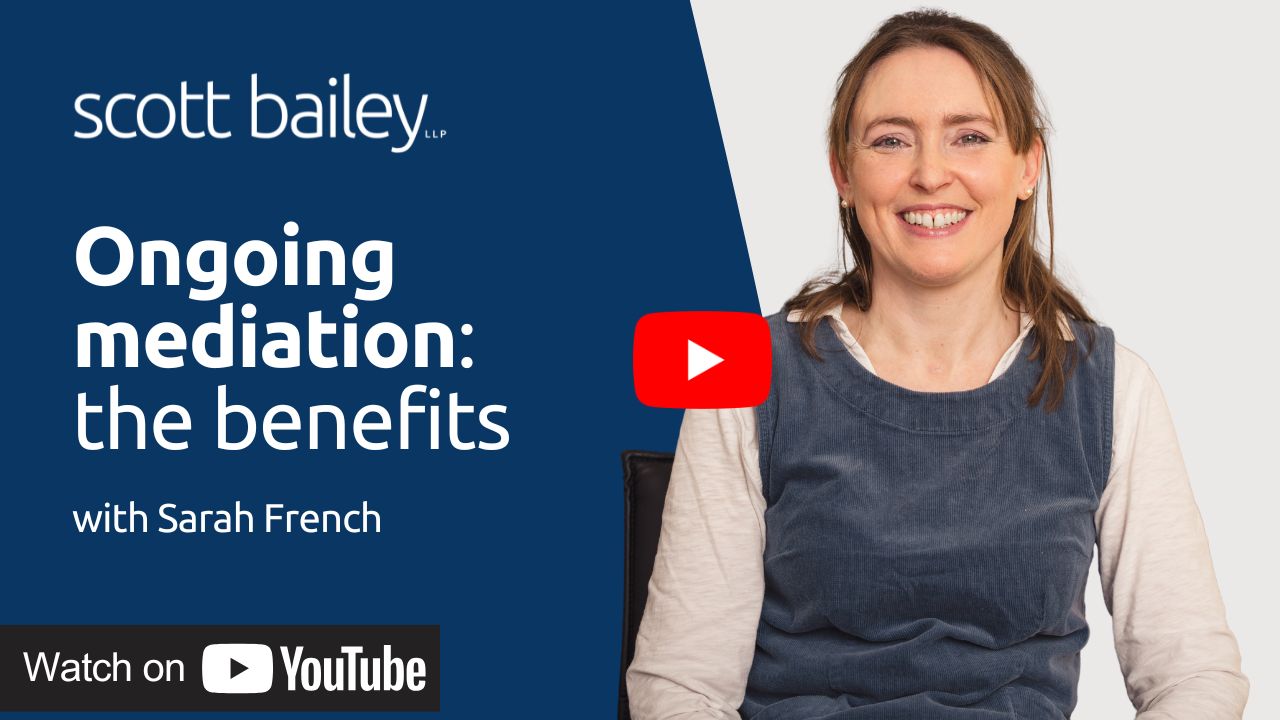
Ongoing Mediation: click to video
The everyday decisions that can become difficult
As children grow, new questions arise. Which secondary school should they attend? How should extracurricular activities be funded? Do they need support choosing their GCSE or A-level subjects -and do your opinions on this differ?
Even practical discussions about school trips, uniforms or activity costs can become strained if communication between parents has broken down.
Mediation provides a calm, structured setting to work through these issues. It helps avoid misunderstandings that can easily arise through text messages or informal conversations.
Holidays, passports and travel abroad
Trips abroad are a natural part of family life as children get older. Most of the time, parents agree without difficulty. Where questions do arise, mediation can provide a helpful forum to discuss practical matters such as travel details, accommodation, emergency contacts and arrangements for holding and providing the child’s passport.
Addressing these points in advance often prevents last-minute disputes and unnecessary anxiety.
Medical decisions and parental responsibility
Decisions about a child’s health fall under parental responsibility. In most cases, parents are expected to agree to significant or ongoing medical treatment.
If agreement cannot be reached, the court can decide what is in the child’s best interests. However, mediation often enables parents to address concerns much earlier and in a less adversarial way. It is also far more flexible than court proceedings and can often be arranged quickly if a decision is urgent.
The teenage years
Parenting teenagers brings new challenges. Questions about mobile phones, independence, social lives and independent travel can generate strong views on all sides.
While some earlier arrangements may fall away, new ones take their place. Many of the decisions parents face later were never anticipated during initial mediation sessions. Booking a review session to discuss these new issues often prevents them from developing into more serious disputes.
Ongoing mediation helps parents maintain a united approach, reduces the risk of mixed messages and avoids children feeling caught between them.
Planning for change
When parents create a parenting plan through mediation, it can be sensible to agree review points. This simply means committing to revisit arrangements at key stages in a child’s life or at agreed intervals.
Seeing mediation as an ongoing option rather than a one-off process is often a strength. It allows families to adapt constructively as life evolves.
Frequently asked questions
Can I take my child abroad without the other parent’s permission?
If both parents have parental responsibility, consent is usually required before a child is taken abroad, even for a holiday. There are limited exceptions, but where agreement cannot be reached, mediation is often used before considering court proceedings.
Can a parent withhold a child’s passport?
A child’s passport belongs to the child, not either parent. Unreasonably refusing to release it can create legal difficulties, particularly if travel arrangements have been agreed. Mediation can help parents agree practical arrangements for holding and sharing passports to avoid future conflict.
Is mediation legally binding?
Mediation itself is not legally binding. Agreements are usually recorded in a parenting plan or memorandum of understanding. If parents wish, the terms can be converted into a consent order and approved by the court to make them binding.
Mediation at Scott Bailey Solicitors
Life is unpredictable. Changes may be positive or challenging, planned or unexpected. Research consistently shows that it is parental conflict, rather than separation itself, that is most damaging to children.
Building mediation into your co-parenting arrangements should never be viewed as a weakness - it is a constructive way of future-proofing your family.
The expert family mediators at Scott Bailey offer appointments at their Lymington and Lyndhurst offices, as well as by video call where appropriate.

For more information on Scott Bailey, including the full breadth of services:
Contact Scott Bailey for a confidential initial meeting
Call- 01590 676933
Email-
Website- scottbailey.co.uk
Sign up for Scott Bailey's newsletter here
Find out more about Scott Bailey LLP, including opening hours and social media links.
About Scott Bailey LLP
Founded in 1930, Scott Bailey has grown to become a leading firm in the New Forest, providing a full range of legal services to private individuals and businesses. Services for individuals include Residential Conveyancing, Divorce, Family, Wills Trusts & Probate, Litigation & Disputes.
SME business legal services include Corporate, Commercial, Intellectual Property, Dispute Resolution, Landlord & Tenant, Insolvency and Employment Law. Scott Bailey LLP is one of only a very few firms based in the New Forest providing these specialist services.
The first firm in the region to receive the Law Society's prestigious LEXCEL award for high standards of practice management and customer care, Scott Bailey LLP promises top-quality, professional help from a team of expert solicitors who will put your best interests at the heart of their work.
Scott Bailey was delighted and proud to win "Business of the Year" at the 2023 New Forest Brilliance in Business Awards.
